Introduction to Stack Data Structure
Content:
<h1>Introduction to Stack Data Structure</h1>
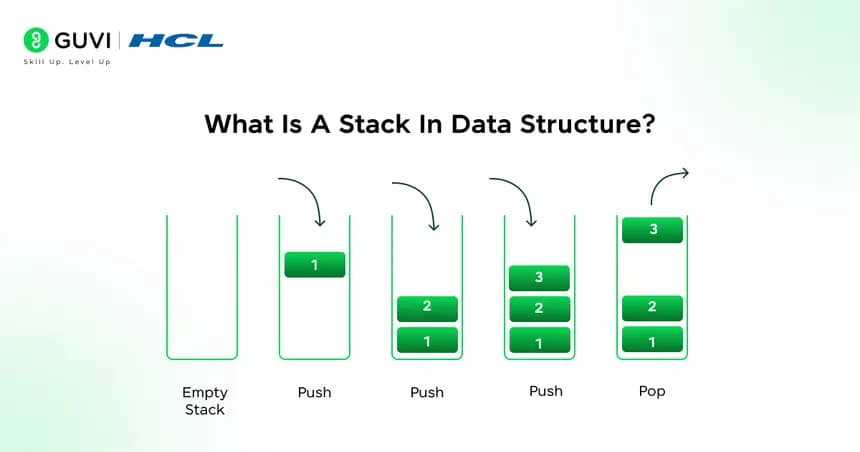
<p>A <b>Stack</b> is a fundamental linear data structure that follows the principle of <b>Last In, First Out (LIFO)</b>. This means the element that is inserted last is the first one to be removed.</p>
<p>Stacks are heavily used in system-level components such as <a href="/blogs/introduction-to-operating-systems">Operating Systems</a>, compiler design, and algorithm implementation discussed under <a href="/blogs/introduction-to-data-structures-and-algorithms">Data Structures and Algorithms</a>.</p>
<hr/>
<h2>1. Basic Concept of Stack</h2>
<p>A stack can be visualized as a vertical pile of plates. You can only add a plate to the top and remove the plate from the top.</p>
<p>This restricted access makes stacks ideal for problems where the most recent data needs to be accessed first.</p>
<hr/>
<h2>2. Core Operations on Stack</h2>
<ul>
<li><b>Push</b> – Insert an element at the top of the stack.</li>
<li><b>Pop</b> – Remove the top element from the stack.</li>
<li><b>Peek / Top</b> – View the top element without removing it.</li>
<li><b>isEmpty</b> – Check whether the stack is empty.</li>
<li><b>isFull</b> – Check whether the stack is full (in static stacks).</li>
</ul>
<p>These operations are designed to work in constant time, making stacks efficient.</p>
<hr/>
<h2>3. Stack Implementation Techniques</h2>
<ul>
<li><b>Array-based Implementation</b> – Uses a fixed or dynamic array.</li>
<li><b>Linked List Implementation</b> – Uses nodes where insertion and deletion occur at one end.</li>
</ul>
<p>Memory allocation for stack operations is handled by <a href="/blogs/introduction-to-operating-systems">Operating Systems</a>, especially in function call stacks.</p>
<hr/>
<h2>4. Stack Memory and Call Stack</h2>
<p>The <b>call stack</b> is a special stack used by programs to keep track of function calls.</p>
<p>Each function call pushes activation records onto the stack, and returning from a function pops them off.</p>
<p>This mechanism is critical for recursion, which is widely used in <a href="/blogs/introduction-to-data-structures-and-algorithms">algorithm design</a>.</p>
<hr/>
<h2>5. Applications of Stack</h2>
<ul>
<li>Function calls and recursion handling</li>
<li>Expression evaluation (infix, postfix, prefix)</li>
<li>Undo and redo operations</li>
<li>Syntax parsing in compilers</li>
<li>Backtracking algorithms</li>
</ul>
<p>Stacks are also used internally by interpreters and compilers built using <a href="/blogs/introduction-to-software-engineering">Software Engineering</a> principles.</p>
<hr/>
<h2>6. Stack in Algorithms</h2>
<p>Stacks are essential for solving many classic problems such as:</p>
<ul>
<li>Balanced parentheses checking</li>
<li>Depth-First Search (DFS)</li>
<li>Reversing data</li>
<li>Next greater element problems</li>
</ul>
<p>These problems are commonly discussed in <a href="/blogs/introduction-to-data-structures-and-algorithms">DSA fundamentals</a>.</p>
<hr/>
<h2>7. Advantages of Stack</h2>
<ul>
<li>Simple and easy to implement</li>
<li>Efficient memory usage</li>
<li>Fast access to recent elements</li>
</ul>
<hr/>
<h2>8. Limitations of Stack</h2>
<ul>
<li>No random access to elements</li>
<li>Stack overflow and underflow issues</li>
</ul>
<p>Stack overflow errors are common in deeply recursive programs and are managed at the system level by the operating system.</p>
<hr/>
<h2>9. Stack vs Other Data Structures</h2>
<p>Unlike <a href="/blogs/introduction-to-queue-data-structure">Queues</a>, stacks process data in reverse order of insertion.</p>
<p>This makes stacks suitable for problems where reverse traversal or backtracking is required.</p>
<hr/>
<p>The stack data structure is a core building block of computer science and plays a vital role in algorithms, operating systems, compilers, and modern software systems.</p>
Written by
Admin
Expert education content writer at StuTeach with extensive knowledge in Indian education systems, tutoring methodologies, and student success strategies. Specializes in data-structures, stack, computer-science.