Introduction to Recursion
<h1>Introduction to Recursion</h1>
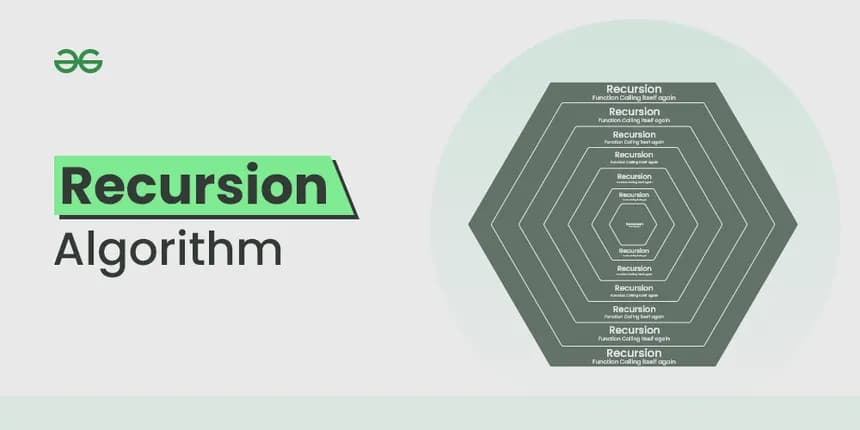
<p><b>Recursion</b> is a programming technique where a function calls itself directly or indirectly to solve a problem by breaking it down into smaller subproblems.</p>
<p>Recursion is a fundamental concept in <a href="/blogs/introduction-to-data-structures-and-algorithms">Data Structures and Algorithms</a> and is deeply connected with <a href="/blogs/introduction-to-stack-data-structure">Stack Data Structure</a>, <a href="/blogs/introduction-to-operating-systems">Operating Systems</a>, and applications built using <a href="/blogs/introduction-to-software-engineering">Software Engineering</a>.</p>
<hr/>
<h2>1. Why Recursion is Used</h2>
<p>Some problems are naturally recursive in nature, such as tree traversal, divide-and-conquer algorithms, and mathematical computations.</p>
<p>Recursion simplifies code logic for complex problems commonly found in <a href="/blogs/introduction-to-artificial-intelligence-ai">Artificial Intelligence</a> and algorithmic problem-solving.</p>
<hr/>
<h2>2. How Recursion Works</h2>
<p>A recursive function consists of two main parts:</p>
<ul>
<li><b>Base Case</b> – The condition that stops recursion.</li>
<li><b>Recursive Case</b> – The part where the function calls itself.</li>
</ul>
<p>Without a proper base case, recursion leads to infinite calls and stack overflow.</p>
<hr/>
<h2>3. Recursion and Call Stack</h2>
<p>Each recursive call is stored in the <b>call stack</b>.</p>
<p>The call stack is implemented using the <a href="/blogs/introduction-to-stack-data-structure">Stack Data Structure</a> and managed by the <a href="/blogs/introduction-to-operating-systems">Operating System</a>.</p>
<hr/>
<h2>4. Types of Recursion</h2>
<ul>
<li><b>Direct Recursion</b></li>
<li><b>Indirect Recursion</b></li>
<li><b>Tail Recursion</b></li>
</ul>
<p>Tail recursion is optimized by some compilers to reduce stack usage.</p>
<hr/>
<h2>5. Recursion in Algorithms</h2>
<p>Many popular algorithms are recursive in nature:</p>
<ul>
<li>Merge Sort</li>
<li>Quick Sort</li>
<li>Binary Search</li>
<li>Tree Traversals</li>
</ul>
<p>These algorithms are core topics in <a href="/blogs/introduction-to-data-structures-and-algorithms">DSA</a>.</p>
<hr/>
<h2>6. Recursion in Data Structures</h2>
<p>Recursive techniques are commonly used with trees and graphs.</p>
<p>DFS in <a href="/blogs/introduction-to-graph-data-structure">Graph Data Structure</a> is a classic example of recursion.</p>
<hr/>
<h2>7. Advantages of Recursion</h2>
<ul>
<li>Simpler and cleaner code</li>
<li>Natural solution for hierarchical problems</li>
</ul>
<hr/>
<h2>8. Limitations of Recursion</h2>
<ul>
<li>High memory usage due to stack calls</li>
<li>Risk of stack overflow</li>
</ul>
<p>For performance-critical systems, iterative solutions may be preferred.</p>
<hr/>
<h2>9. Recursion vs Iteration</h2>
<p>Recursion uses function calls, while iteration uses loops.</p>
<p>Iteration is often more memory-efficient but may reduce code readability.</p>
<hr/>
<p>Recursion is a powerful problem-solving technique that forms the backbone of many algorithms, data structures, and intelligent systems.</p>
Written by
Admin
Expert education content writer at StuTeach with extensive knowledge in Indian education systems, tutoring methodologies, and student success strategies. Specializes in recursion, algorithms, data-structure.