
Concurrency and Multithreading in Operating Systems
<h1>Concurrency and Multithreading in Operating Systems</h1>
<p><b>Concurrency</b> refers to the ability of a system to manage multiple tasks at the same time, while <b>Multithreading</b> allows a single process to execute multiple threads concurrently.</p>
<p>These concepts are central to <a href="/blogs/introduction-to-operating-systems">Operating Systems</a> and are critical for building high-performance systems such as <a href="/blogs/introduction-to-database-management-systems-dbms">DBMS</a>, scalable applications developed using <a href="/blogs/introduction-to-software-engineering">Software Engineering</a>, and real-time platforms used in <a href="/blogs/introduction-to-artificial-intelligence-ai">Artificial Intelligence</a>.</p>
<hr/>
<h2>1. Why Concurrency is Important</h2>
<p>Modern computers have multi-core processors. Concurrency ensures that CPU resources are fully utilized by allowing multiple tasks to progress simultaneously.</p>
<p>Without concurrency, systems would waste computational power and become unresponsive under heavy workloads.</p>
<hr/>
<h2>2. Process vs Thread</h2>
<ul>
<li><b>Process</b> – An independent program in execution with its own memory space.</li>
<li><b>Thread</b> – A lightweight unit of execution within a process.</li>
</ul>
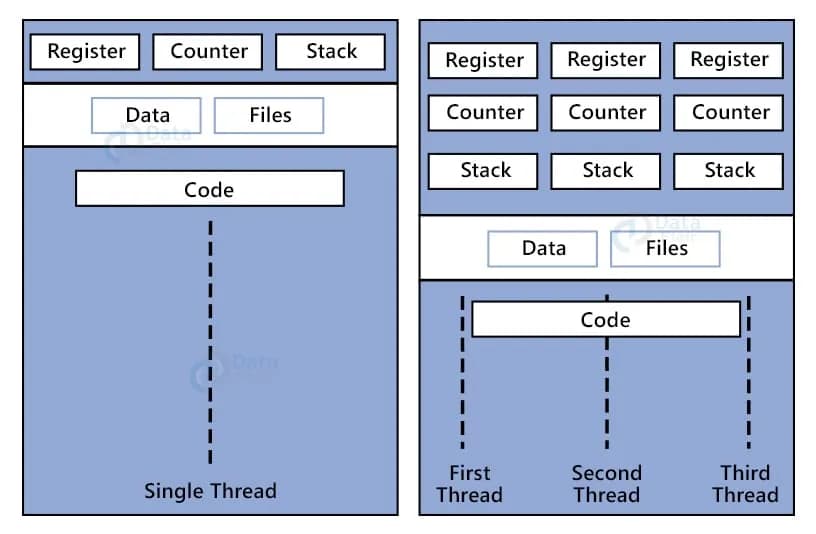
<p>Threads share memory and resources, making them faster to create and switch than processes.</p>
<hr/>
<h2>3. Multithreading Model</h2>
<p>In multithreading, a single process can perform multiple tasks simultaneously.</p>
<p>Examples include web servers handling multiple client requests or databases executing concurrent queries.</p>
<p>Thread scheduling and execution are managed by the <a href="/blogs/introduction-to-operating-systems">Operating System</a>.</p>
<hr/>
<h2>4. Thread States and Life Cycle</h2>
<ul>
<li>New</li>
<li>Ready</li>
<li>Running</li>
<li>Waiting</li>
<li>Terminated</li>
</ul>
<p>Efficient state transitions are essential for system responsiveness and throughput.</p>
<hr/>
<h2>5. Synchronization and Critical Section</h2>
<p>When multiple threads access shared data, race conditions may occur.</p>
<p>Synchronization techniques ensure data consistency:</p>
<ul>
<li>Mutex Locks</li>
<li>Semaphores</li>
<li>Monitors</li>
</ul>
<p>These mechanisms rely on algorithmic principles discussed in <a href="/blogs/introduction-to-data-structures-and-algorithms">DSA</a>.</p>
<hr/>
<h2>6. Concurrency Issues</h2>
<ul>
<li>Race Conditions</li>
<li>Deadlocks</li>
<li>Starvation</li>
<li>Priority Inversion</li>
</ul>
<p>Deadlocks are discussed in detail in <a href="/blogs/deadlock-in-operating-systems">Deadlock Concepts</a>.</p>
<hr/>
<h2>7. Concurrency in Databases and AI Systems</h2>
<p>Databases must support concurrent transactions while maintaining data consistency.</p>
<p><a href="/blogs/introduction-to-database-management-systems-dbms">DBMS</a> uses locking protocols and isolation levels to manage concurrency.</p>
<p>AI systems use multithreading to parallelize model training and inference workloads.</p>
<hr/>
<h2>8. Advantages of Multithreading</h2>
<ul>
<li>Better CPU utilization</li>
<li>Improved application responsiveness</li>
<li>Scalable performance on multi-core systems</li>
</ul>
<hr/>
<h2>9. Limitations and Challenges</h2>
<ul>
<li>Complex debugging</li>
<li>Synchronization overhead</li>
<li>Risk of deadlocks</li>
</ul>
<hr/>
<h2>10. External Resources</h2>
<ul>
<li>Wikipedia – Concurrency: https://en.wikipedia.org/wiki/Concurrency_(computer_science)</li>
<li>Wikipedia – Multithreading: https://en.wikipedia.org/wiki/Multithreading_(computer_architecture)</li>
<li>MIT Concurrency Lecture (YouTube): https://www.youtube.com/watch?v=KXJ8qY5WcBU</li>
<li>GeeksforGeeks – Multithreading: https://www.geeksforgeeks.org/multithreading-in-operating-system/</li>
</ul>
<hr/>
<p>Concurrency and multithreading are essential for building responsive, scalable, and high-performance systems in modern computing environments.</p>
Written by
Admin
Expert education content writer at StuTeach with extensive knowledge in Indian education systems, tutoring methodologies, and student success strategies. Specializes in concurrency, multithreading, operating-system.