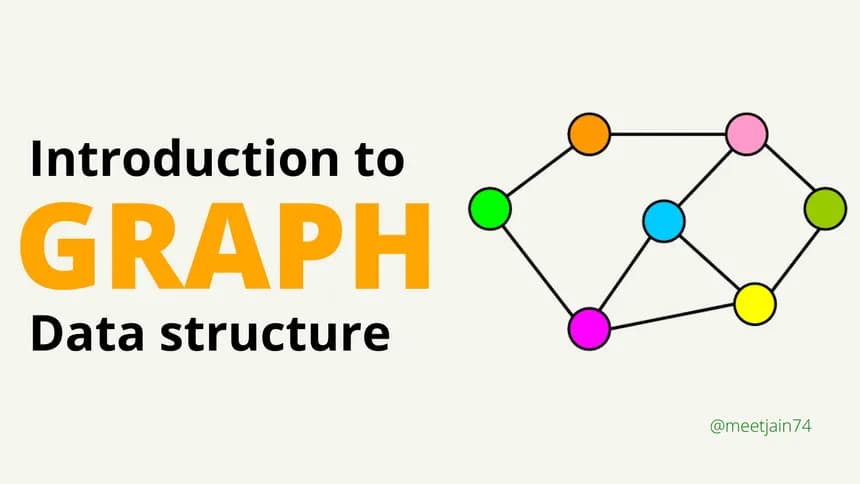
Introduction to Graph Data Structure
<h1>Introduction to Graph Data Structure</h1>
<p>A <b>Graph</b> is a non-linear data structure consisting of a set of vertices (nodes) and edges that connect pairs of vertices. Graphs are used to model complex relationships such as networks, dependencies, and connections.</p>
<p>Graphs are a core topic in <a href="/blogs/introduction-to-data-structures-and-algorithms">Data Structures and Algorithms</a> and are foundational for systems involving <a href="/blogs/introduction-to-computer-networks">Computer Networks</a>, <a href="/blogs/introduction-to-artificial-intelligence-ai">Artificial Intelligence</a>, and scalable platforms built using <a href="/blogs/introduction-to-software-engineering">Software Engineering</a>.</p>
<hr/>
<h2>1. Why Graphs Are Important</h2>
<p>Many real-world problems cannot be represented linearly or hierarchically. Graphs allow modeling of many-to-many relationships.</p>
<p>Examples include social networks, routing systems, and dependency resolution in operating systems.</p>
<hr/>
<h2>2. Basic Terminology of Graphs</h2>
<ul>
<li><b>Vertex (Node)</b> – Fundamental unit of the graph</li>
<li><b>Edge</b> – Connection between two vertices</li>
<li><b>Directed Graph</b> – Edges have direction</li>
<li><b>Undirected Graph</b> – Edges have no direction</li>
<li><b>Weighted Graph</b> – Edges have associated weights</li>
</ul>
<p>These concepts are crucial for graph traversal and optimization algorithms.</p>
<hr/>
<h2>3. Graph Representation</h2>
<ul>
<li><b>Adjacency Matrix</b></li>
<li><b>Adjacency List</b></li>
</ul>
<p>Adjacency lists are preferred for sparse graphs due to better space efficiency, a common concern in <a href="/blogs/introduction-to-operating-systems">Operating Systems</a>.</p>
<hr/>
<h2>4. Graph Traversal Algorithms</h2>
<ul>
<li><b>Breadth-First Search (BFS)</b></li>
<li><b>Depth-First Search (DFS)</b></li>
</ul>
<p>BFS uses <a href="/blogs/introduction-to-queue-data-structure">Queues</a>, while DFS relies on <a href="/blogs/introduction-to-stack-data-structure">Stacks</a>.</p>
<hr/>
<h2>5. Important Graph Algorithms</h2>
<ul>
<li>Dijkstra’s Shortest Path Algorithm</li>
<li>Bellman-Ford Algorithm</li>
<li>Minimum Spanning Tree (Prim’s, Kruskal’s)</li>
<li>Topological Sorting</li>
</ul>
<p>These algorithms are essential in routing, scheduling, and dependency management systems.</p>
<hr/>
<h2>6. Graphs in Computer Networks</h2>
<p>Networks are naturally represented as graphs where devices are nodes and connections are edges.</p>
<p>Routing protocols rely on shortest-path algorithms to efficiently transfer data across <a href="/blogs/introduction-to-computer-networks">Computer Networks</a>.</p>
<hr/>
<h2>7. Graphs in Artificial Intelligence</h2>
<p>AI systems use graphs for knowledge representation, planning, and decision-making.</p>
<p>Search algorithms in <a href="/blogs/introduction-to-artificial-intelligence-ai">Artificial Intelligence</a> often traverse state-space graphs.</p>
<hr/>
<h2>8. Advantages of Graphs</h2>
<ul>
<li>Powerful modeling of complex relationships</li>
<li>Flexible and scalable structure</li>
</ul>
<hr/>
<h2>9. Limitations of Graphs</h2>
<ul>
<li>High memory usage for dense graphs</li>
<li>Algorithmic complexity</li>
</ul>
<hr/>
<p>Graph data structures are indispensable for modern computing systems, enabling efficient solutions in networking, artificial intelligence, databases, and large-scale software platforms.</p>
Written by
Admin
Expert education content writer at StuTeach with extensive knowledge in Indian education systems, tutoring methodologies, and student success strategies. Specializes in graph-data-structure, data-structure, algorithms.