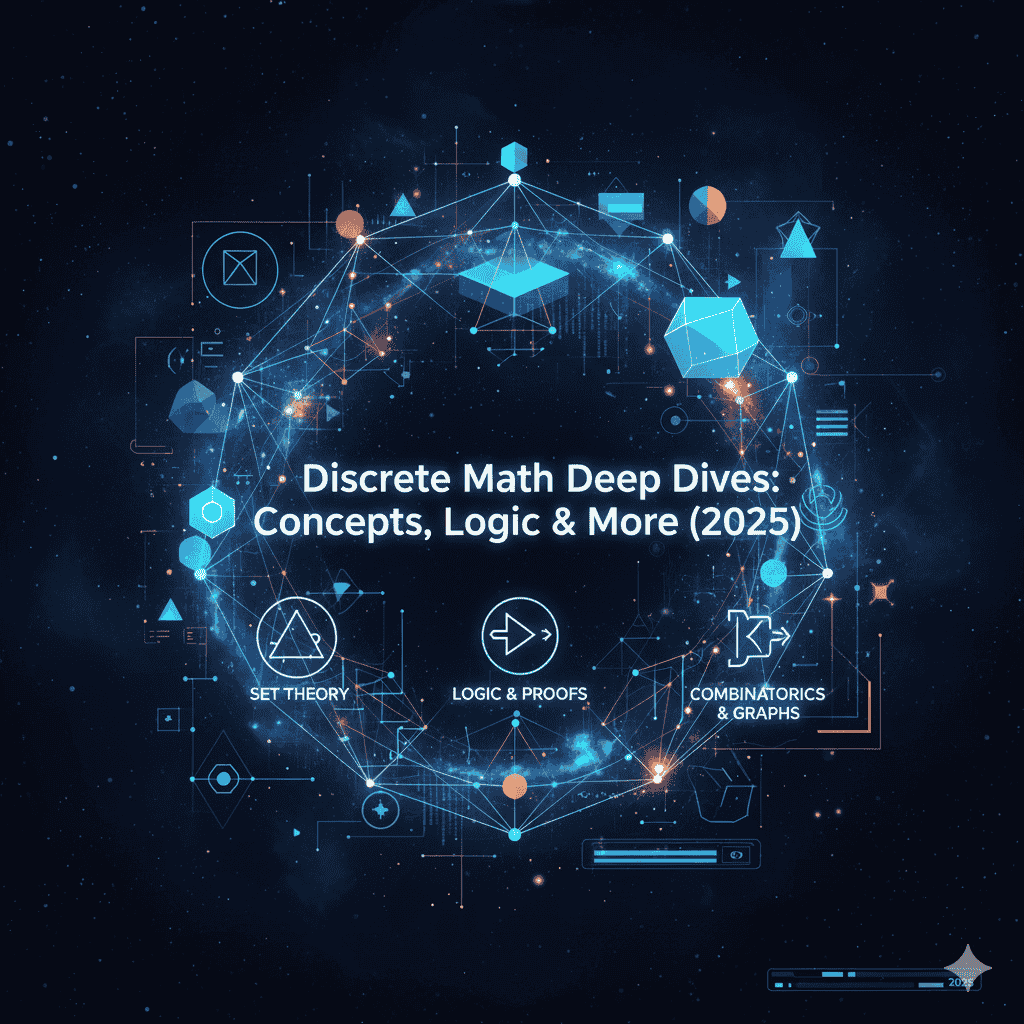
Discrete Math Deep Dives: Concepts, Logic & More (2025)
<p>Discrete Mathematics is the backbone of modern computing and logical problem-solving. It deals with distinct, countable elements rather than continuous ones — making it essential for algorithms, programming, data structures, cryptography, and artificial intelligence. This page takes a deep dive into the <strong>core concepts of discrete math</strong> and how they apply in real-world computing.</p> <h2><strong>1. Set Theory – The Foundation of Data Organization</strong></h2> <p>Set Theory forms the basis of data grouping, database design, and logic building in computer science.</p> <p><strong>Key Concepts:</strong></p> <ul> <li><strong>Set:</strong> A collection of distinct objects (e.g., A = {2, 4, 6, 8})</li> <li><strong>Subset & Superset:</strong> Relationship between sets based on elements.</li> <li><strong>Union (∪), Intersection (∩), Difference (-):</strong> Used for combining or comparing datasets.</li> <li><strong>Complement:</strong> Elements not belonging to a given set.</li> </ul> <p><strong>Real-World Application:</strong> Database queries use set operations (e.g., SQL “UNION”, “INTERSECT”) to retrieve or compare information.</p> <h2><strong>2. Logic and Propositional Calculus – The Language of Computers</strong></h2> <p>Logic defines the rules for reasoning, decision-making, and computation. It helps computers perform conditional operations.</p> <p><strong>Core Concepts:</strong></p> <ul> <li><strong>Propositions:</strong> Statements that are either true or false.</li> <li><strong>Connectives:</strong> AND (∧), OR (∨), NOT (¬), IMPLIES (→).</li> <li><strong>Truth Tables:</strong> Evaluate outcomes of logical expressions.</li> <li><strong>Logical Equivalence:</strong> Simplifying complex logical formulas.</li> </ul> <p><strong>Real-World Application:</strong> Boolean logic drives programming conditions, digital circuits, and search engine query design.</p> <h2><strong>3. Relations and Functions – Structuring Relationships</strong></h2> <p>Relations define how elements of one set relate to another. Functions describe one-to-one or one-to-many mappings — key in software design and database systems.</p> <p><strong>Examples:</strong></p> <ul> <li><strong>Reflexive, Symmetric, Transitive Relations:</strong> Used in modeling data hierarchies.</li> <li><strong>Injective, Surjective, Bijective Functions:</strong> Represent precise data mappings.</li> </ul> <p><strong>Real-World Application:</strong> Functions define mappings in programming (e.g., hash functions), and relations are used in databases for foreign-key associations.</p> <h2><strong>4. Graph Theory – Modeling Connections and Networks</strong></h2> <p>Graph Theory studies nodes (vertices) and connections (edges). It models relationships and movements in systems, from social networks to routing algorithms.</p> <p><strong>Key Concepts:</strong></p> <ul> <li><strong>Types of Graphs:</strong> Directed, Undirected, Weighted, Cyclic, Acyclic.</li> <li><strong>Paths and Circuits:</strong> Represent routes or sequences of operations.</li> <li><strong>Trees:</strong> Special acyclic graphs used in hierarchical data representation.</li> <li><strong>Graph Traversal:</strong> BFS (Breadth-First Search) and DFS (Depth-First Search).</li> </ul> <p><strong>Real-World Application:</strong> Graphs are used in Google Maps, network routing, dependency resolution, and social media connection analysis.</p> <h2><strong>5. Combinatorics – Counting and Arrangements</strong></h2> <p>Combinatorics focuses on counting, combinations, and permutations — fundamental in probability, data compression, and optimization.</p> <p><strong>Key Ideas:</strong></p> <ul> <li><strong>Factorials (n!):</strong> Number of ways to arrange items.</li> <li><strong>Permutations:</strong> Ordered arrangements of elements.</li> <li><strong>Combinations:</strong> Selection of elements regardless of order.</li> <li><strong>Pigeonhole Principle:</strong> Ensures at least one overlap in certain conditions.</li> </ul> <p><strong>Real-World Application:</strong> Used in password security, probability models, scheduling, and algorithm complexity analysis.</p> <h2><strong>6. Number Theory – The Core of Cryptography</strong></h2> <p>Number Theory studies properties of integers — prime numbers, divisibility, and modular arithmetic — forming the basis of encryption algorithms.</p> <p><strong>Important Concepts:</strong></p> <ul> <li><strong>Prime Numbers:</strong> Building blocks of cryptographic keys.</li> <li><strong>Modular Arithmetic:</strong> Key for encoding/decoding information (a mod n).</li> <li><strong>Greatest Common Divisor (GCD):</strong> Essential in algorithm optimization.</li> </ul> <p><strong>Real-World Application:</strong> RSA encryption, blockchain security, and digital signatures all rely on number theory.</p> <h2><strong>7. Recurrence Relations – Predicting Sequences</strong></h2> <p>Recurrence relations express a sequence where each term depends on previous ones — crucial in algorithm analysis and dynamic programming.</p> <p><strong>Examples:</strong></p> <ul> <li>Fibonacci sequence: F(n) = F(n-1) + F(n-2)</li> <li>Time complexity recurrence: T(n) = 2T(n/2) + n</li> </ul> <p><strong>Real-World Application:</strong> Used to estimate algorithm performance and memory usage in recursive programs.</p> <h2><strong>8. Probability and Counting in Discrete Systems</strong></h2> <p>Discrete probability focuses on events that can be counted — dice rolls, random selections, and data sampling.</p> <p><strong>Core Concepts:</strong></p> <ul> <li>Sample Space and Events</li> <li>Conditional Probability</li> <li>Bayes’ Theorem</li> <li>Expected Value</li> </ul> <p><strong>Real-World Application:</strong> Data analytics, AI decision-making, and prediction models all rely on discrete probability.</p> <hr/> <h2><strong>Final Thoughts</strong></h2> <p>Discrete Mathematics isn’t just theory — it’s the language of logic that powers modern computing. From designing secure systems to optimizing algorithms, these concepts shape how technology works.</p> <p><strong>Remember:</strong> Understanding discrete math means understanding how computers think, decide, and solve problems.</p> <hr/> <p><strong>Written by:</strong> Atanu Saha<br/> <em>Computer Science Student • Discrete Mathematics Researcher • Tech Education Writer</em></p>
Written by
Admin
Expert education content writer at StuTeach with extensive knowledge in Indian education systems, tutoring methodologies, and student success strategies. Specializes in discrete mathematics, discrete math concepts, mathematical logic.